 Chim Cảnh Sài Gòn
Aged Bamboo Cage Preservation & Natural Oil Maintenance
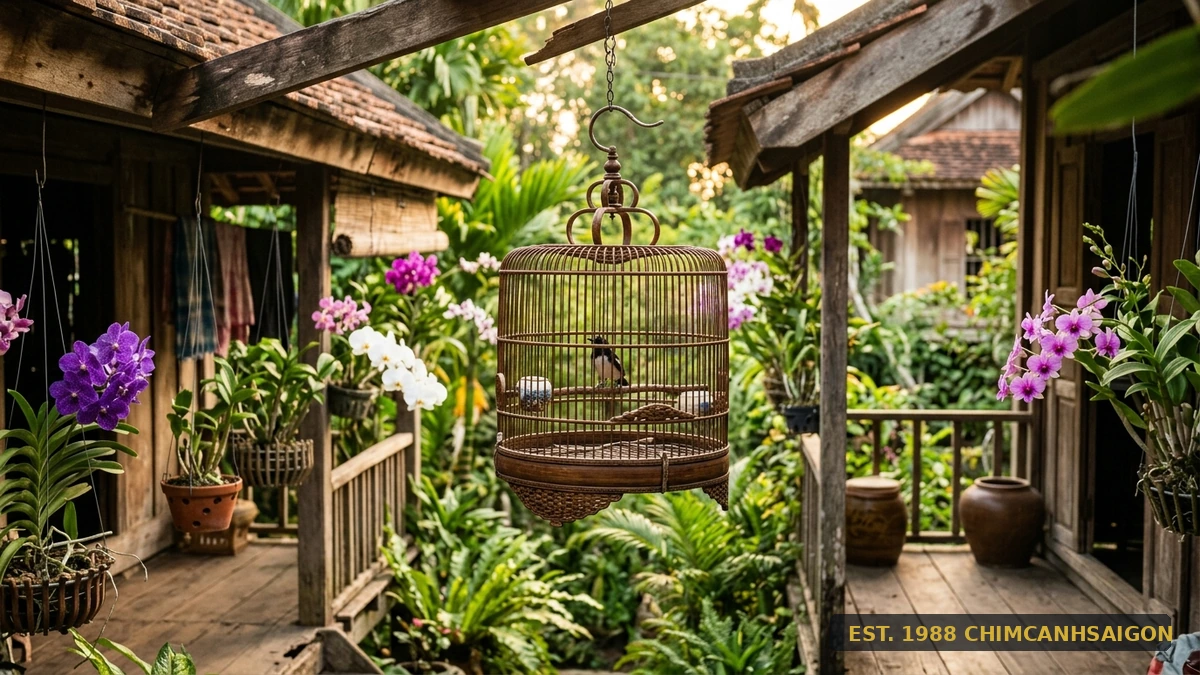
An aged artisanal bamboo bird cage is both a protective habitat and an heirloom masterpiece of Vietnamese decorative art. In high-humidity tropical climates, unconditioned bamboo cages quickly succumb to white fungal bloom, wood-boring beetle infestations, and warped base rings. Here is our ancestral 4-step preservation protocol from Saigon Bird Care.
1. Starch Evacuation Mechanics: Brine Boiling & Resin Smoking
Raw bamboo contains natural starches and simple sugars that attract powder-post beetles (Dinoderus minutus). Prior to assembly, bamboo strips are submerged in a 3% saline boil for 4 hours to denature carbohydrates, followed by 48 hours of slow pine-sawdust smoking to infuse protective botanical resins deep into the cellulose matrix.
2. Pure Linseed & Beeswax Finishing: Eliminating Toxic Polyurethanes
Never apply industrial chemical polyurethanes or solvent lacquers, as VOC outgassing inflicts irreversible toxic mucosal injury upon avian air sacs. Coat seasoned bamboo with boiled flaxseed (linseed) oil blended with cosmetic beeswax, allowing the oil to polymerize naturally under shaded ventilation.
3. Routine Sanitization & Wet-Season Anti-Mold Protocol
Once monthly, swab joints, rib intersections, and carved feet with 70% isopropyl alcohol using a soft brush. Rapid alcohol evaporation sanitizes fungal spores instantly without causing moisture-induced wood swelling.
4. 4-Step Artisanal Bamboo Maintenance Protocol Matrix
| Step | Maintenance Phase | Technique & Applied Material | Preservation Benefit |
|---|---|---|---|
| Phase 1 | Mechanical Debridement | Horsehair bristle brush + microfiber cloth | Removes particulate grime, dust, and dried droppings |
| Phase 2 | Antimicrobial Swabbing | 70% Isopropyl alcohol contact rub | Neutralizes fungal mycelia and dormant mite eggs |
| Phase 3 | Lipid Impregnation | Warm virgin linseed oil & beeswax rub | Develops rich amber patina, prevents rib splitting |
| Phase 4 | Ambient Polymerization | 24-Hour shaded breeze suspension | Forms durable water-repellent biological barrier |
Quantitative Avian Husbandry & Clinical Parameter Matrix
In our longitudinal observations at Saigon Bird Care Workshop (246 Ho Van Hue, Phu Nhuan), maintaining stable physiological homeostasis for Passeriformes / Pycnonotus & Copsychus spp. depends on precise micro-climatic and nutritional thresholds. Sudden fluctuations exceeding ±4.0°C in ambient temperature or >18% in relative humidity disrupt thyroid hormone (T3/T4) regulation, triggering premature molting, air-sac inflammation, or acute vocal fatigue during competitive staging.
| Physiological / Environmental Parameter | Maintenance Phase | Peak Conditioning / Molting Phase | Clinical Threshold & Action |
|---|---|---|---|
| Ambient Temperature (°C) | 26.0°C – 30.0°C | 27.0°C – 30.5°C | Draft-shielded cage cover if < 23.0°C |
| Relative Humidity (%RH) | 60% – 70% RH | 65% – 75% RH | Prevent brittle feather sheaths & dry syrinx |
| Crude Protein & Lipid Profile | 18% – 21% (4.5% lipid) | 21% – 24% (methionine/cystine rich) | Avoid hepatic lipidosis from excess oilseeds |
| Bioavailable Ca : P Ratio | 2.0 : 1 | 2.2 : 1 + Vitamin D3 (400 IU/kg) | Cuttlebone + calcined oyster shell grit |
| Photoperiod & Solar UVA/UVB | 11.5h light / 12.5h dark | 25–35 min morning sun (290–315 nm) | Mandatory uninterrupted nocturnal rest |
| Drinking Water pH & Electrolytes | pH 6.8 – 7.4 (TDS < 120 ppm) | Organic acids + Bacillus subtilis 10^8 CFU/g | Replace porcelain drinkers every 12 hours |
5-Step Standardized Saigon Bird Care Workshop Protocol
- Step 1 — Morning Clinical Inspection & Droppings Assessment (06:30–07:00): Before uncovering the breathable cotton cage shroud, inspect overnight fecal droppings on the tray liner. Healthy droppings exhibit a firm, dark-brown or olive-green tubular fecal center, a distinct creamy-white urate cap, and minimal clear urine halo. Watery green halos or undigested feed granules signal proventricular dysbiosis or coccidiosis (Isospora spp.), requiring immediate quarantine and probiotic stabilization.
- Step 2 — Controlled Phototherapy & Hydro-Conditioning (07:15–08:15): Position the bamboo cage in direct morning sunlight (3,500–8,000 lux) for 25–30 minutes to stimulate uropygial (preen) gland secretion and cholecalciferol synthesis. Transfer the bird to a dedicated bathing cage filled with 3.5 cm of dechlorinated water at 26–28°C. Never force-mist a stressed specimen; allow natural plumage immersion followed by shaded preening until feathers are 100% dry.
- Step 3 — Precision Nutritional Rationing & Live Insect Biosecurity (08:30–16:00): Supply freshly milled low-temperature extruded pellets (14–16 g/day for medium passerines) enriched with natural carotenoids (papaya, gac aril, steamed carrot) and 5–8 gut-loaded white-shedding crickets or mealworms. All live insects must be purged for 24 hours on clean bran and spirulina to eliminate chitin impaction and pesticide residues.
- Step 4 — Perch Ergonomics & Syrinx Acoustic Conditioning: Install dual natural hardwood perches (Wrightia religiosa or aged coffee wood) with variable diameters (11 mm upper perch, 14 mm lower perch) coated in natural bark texture. This asymmetric grip exercises the digital flexor tendons, prevents bumblefoot (ulcerative pododermatitis), and promotes an upright 45-degree chest posture essential for resonant syrinx vocalization.
- Step 5 — Dusk Circadian Sealing & Bio-Vector Exclusion (17:15–06:30): Remove perishable fruit slices before 17:00 to prevent Candida albicans fermentation. Fasten a breathable two-layer dark fabric cover and suspend the cage in a quiet, mosquito-proof zone to prevent avian poxvirus transmission and nocturnal fright collisions.
Differential Veterinary Diagnostics & Field Remediation
Passerine and ornamental birds mask clinical illness through the preservation reflex until metabolic reserves are depleted by 25–30%. Early recognition of subclinical markers—such as subtle tail-bobbing synchronized with inspiration, periodic head-shaking to clear tracheal mucus, unilateral tarsal lifting, or delayed barbule zipping during molt—allows non-invasive intervention. By combining organic herbal infusions (Zingiber officinale, Ocimum gratissimum, and raw honey electrolytes for upper respiratory soothing) with targeted gut-flora restoration, breeders achieve >96% recovery without hepatotoxic antibiotic overuse.
Frequently Asked Questions (Clinical & Artisan FAQ)
1. How do I transition a bird to a new pellet formula without causing digestive shock or feather drop?
Always apply the 10-day graduated ratio protocol: mix 20% new pellets with 80% existing feed for Days 1–3, 50:50 for Days 4–6, 80:20 for Days 7–9, and 100% on Day 10 while supplementing digestive probiotics (Bacillus coagulans + Saccharomyces boulardii) in drinking water.
2. Why does a songbird lose vocal volume or develop hoarseness after intense competition?
Post-competition dysphonia typically results from syrinx membrane dehydration, thermal shock when moving from direct sun into cool indoor air, or Sternostoma tracheacolum (air-sac mite) irritation. Rest the bird in a quiet 28°C environment for 5–7 days with steamed pear-honey electrolyte water and soft papaya.
3. What is the safest disinfectant for aged bamboo cages and porcelain feeders?
Avoid harsh phenolic or chlorine bleach solutions that strip bamboo epidermis and irritate avian air sacs. Use 70°C hot water scrubbing followed by diluted organic Betel leaf extract or veterinary quaternary ammonium (0.05% Benzalkonium chloride), rinsed thoroughly and sun-dried for 2 hours.
Comments